
AtlasInference: Building Reliable AI Inference Systems
AtlasInference is a documentation-first open source initiative focused on reliable inference systems, evaluation frameworks, and deployment patterns for AI and machine learning infrastructure.
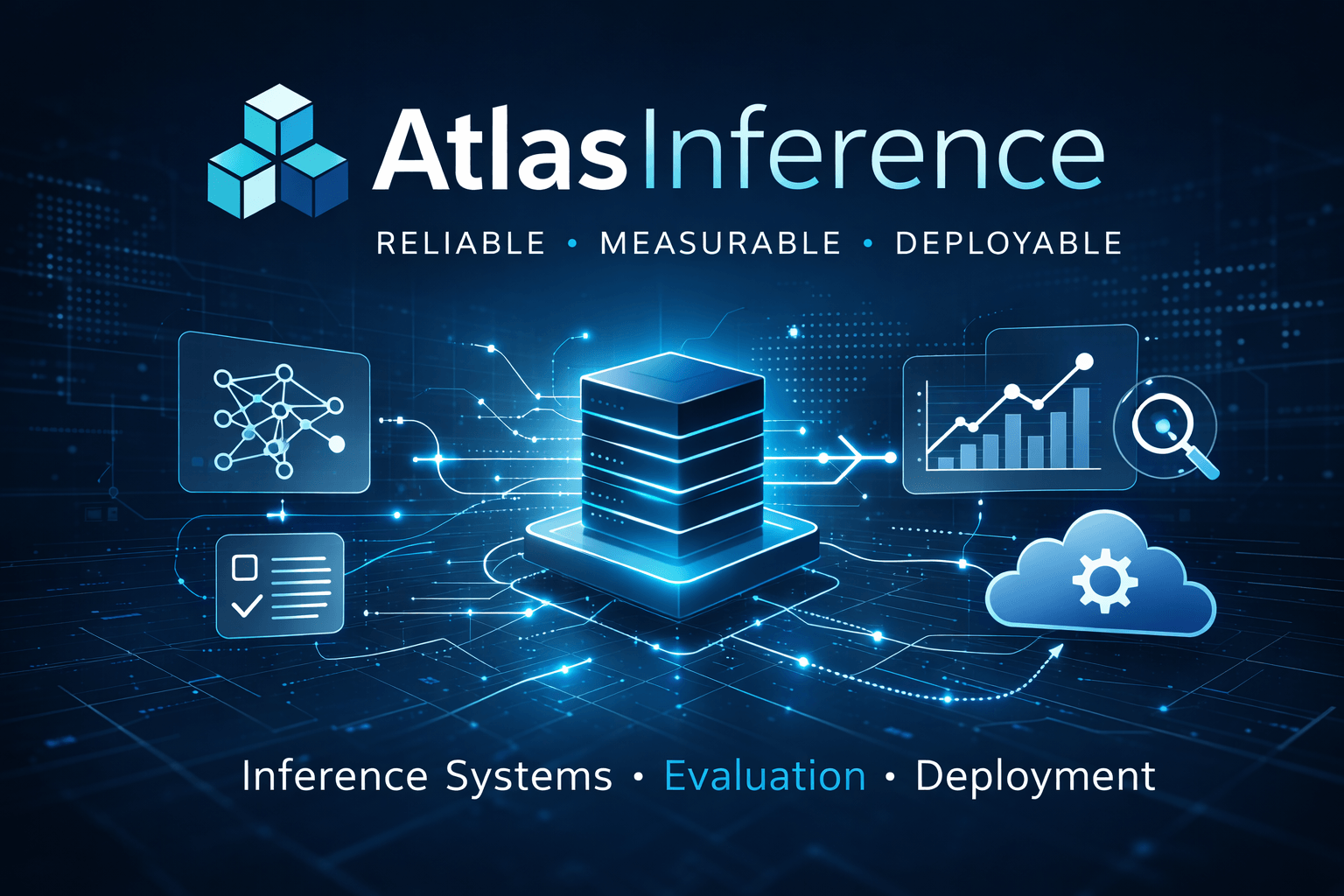
AtlasInference is a documentation-first open source initiative focused on building reliable inference systems. The project develops small, composable tools and reference patterns that make machine learning inference pipelines measurable, explainable, and predictable in production environments.
Rather than emphasizing novelty or experimentation alone, AtlasInference prioritizes clarity, reproducibility, and operational stability. The goal is simple: reduce surprises in production systems by making infrastructure transparent, observable, and easy to reason about.
AtlasInference publishes infrastructure components, evaluation frameworks, and deployment blueprints that teams can adopt incrementally. Each component is designed with stable interfaces, explicit contracts, and strong documentation so developers can understand exactly what the system does and how it behaves under real conditions.
Why AtlasInference Exists
Many machine learning systems work well in demonstrations but become fragile once deployed. Failures often occur at the seams between components: configuration drift, silent regressions, missing observability, or unclear operational expectations.
AtlasInference focuses specifically on these seams. By documenting system boundaries and defining predictable interfaces, the project aims to make inference pipelines easier to maintain and operate over time.
This approach emphasizes measurable system behavior, latency and cost awareness, and infrastructure that can be inspected and debugged when issues arise.
What AtlasInference Builds
AtlasInference produces infrastructure components that support the lifecycle of inference systems, from request handling and evaluation to deployment and monitoring.
Inference Infrastructure
The inference layer focuses on adapters, request contracts, batching, caching, and routing logic that enable models to serve predictions reliably across services. These components emphasize schema-driven interfaces and tracing contexts that persist throughout the entire request pipeline.
Evaluation Frameworks
Evaluation harnesses help teams detect regressions before they reach users. AtlasInference provides tooling for repeatable test suites, benchmark fixtures, and structured reports that allow teams to compare model behavior across versions and deployments.
Model Registries
AtlasInference also explores schema-driven model registries where model metadata, compatibility constraints, and behavioral expectations travel with the model itself rather than being stored informally in documentation or internal notes.
Deployment Blueprints
Deployment blueprints provide reference architectures and operational runbooks for predictable model deployment. These resources include observability patterns, service-level objectives, rollback procedures, and alerting practices designed for real production environments.
Starter Repositories
AtlasInference maintains several starter repositories that provide credible defaults for teams building inference infrastructure.
- Inference Kit: A minimal toolkit for adapters, request schemas, batching, caching strategies, and tracing hooks that allow inference services to scale while remaining observable.
- Evaluation Harness: A command-line evaluation runner with metrics tooling and regression scorecards for repeatable testing of models and prompts.
- Model Registry: A schema-driven manifest system that tracks model versions, constraints, expected behavior, and compatibility requirements in a portable and diffable format.
- Deployment Blueprints: Reference deployment patterns with operational runbooks designed to help teams maintain predictable performance, observability, and rollback capabilities.
Principles
AtlasInference is guided by several core engineering principles.
- Make behavior testable: System changes should produce measurable signals. Evaluation harnesses and reproducible test suites make model behavior observable across versions.
- Make tradeoffs explicit: Latency and cost budgets are engineering decisions. Infrastructure should expose these tradeoffs clearly rather than hiding them behind abstractions.
- Favor boring interfaces: Stable and simple contracts are easier to integrate and maintain. AtlasInference emphasizes predictable APIs and schema-driven communication.
- Observe what matters: Systems cannot be improved if they cannot be understood. Traces, metrics, and logs are treated as first-class infrastructure components.
Documentation-First Development
AtlasInference follows a documentation-first philosophy. Each repository begins with clearly defined contracts, schemas, and examples before expanding into broader implementation details.
This approach encourages contributors to improve clarity at system boundaries and ensures that infrastructure components remain understandable as they evolve.
Contributing
Contributions to AtlasInference are welcome. Improvements often begin with small steps: clarifying documentation, adding examples, tightening schema definitions, or documenting failure modes discovered in real deployments.
The project encourages contributors to open issues with detailed context about their environment, expected behavior, and observed results. Reproducibility and clarity are valued over speculation.
Project Links
AtlasInference is part of the broader ecosystem of open knowledge and infrastructure projects maintained by Brandon Himpfen.