
Himpfen Search: Rethinking the Search Interface for the AI Era
A design proposal exploring how search engines could evolve in the AI era with a three-panel interface separating history, AI understanding, and sources.


For more than two decades, the basic structure of web search has remained surprisingly consistent. A search box at the top. A vertical list of results below. Links, snippets, and occasional modules for maps, images, or shopping. Despite countless improvements in ranking algorithms and the rise of mobile devices, the underlying interface has remained largely recognizable since the early days of Google.
Yet the capabilities behind search have changed dramatically.
Search engines no longer simply retrieve pages. They interpret queries, analyze relationships between documents, and increasingly generate explanations using artificial intelligence. Modern systems can synthesize information across multiple sources, summarize complex topics, and help users refine questions interactively.
Despite these advances, the interface for accessing that information still largely reflects an earlier model of search. The result is a growing mismatch between what search systems can do and how their interfaces present information.
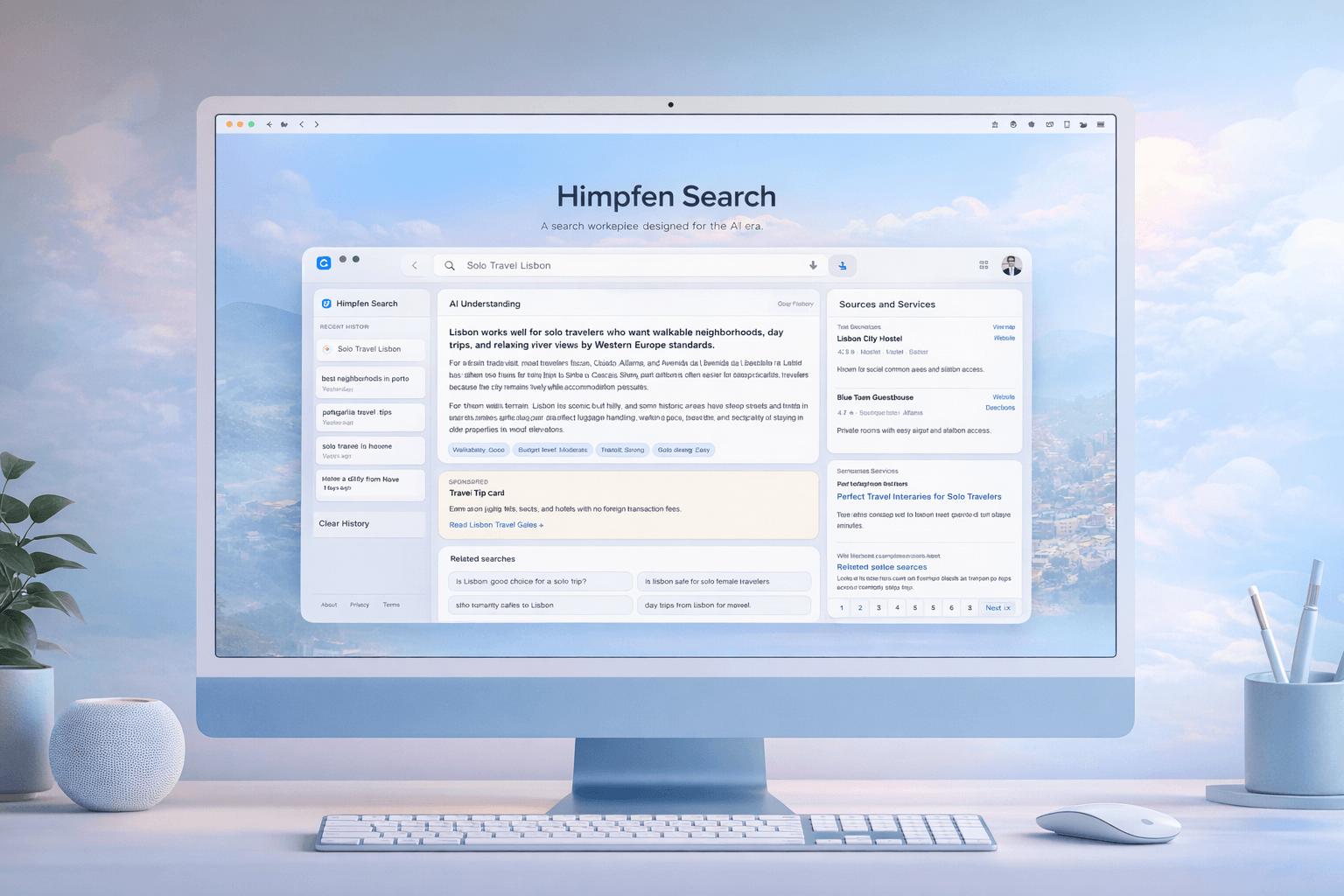
Himpfen Search is a conceptual interface that explores how search might evolve to better reflect the realities of the AI era.
https://brandonhimpfen.github.io/himpfen-search/demo/
Rather than replacing traditional search, the design proposes separating the modern search experience into three distinct layers: search history, AI understanding, and sources.
Together, these elements form a search workspace rather than a single results page.
The Legacy of the “Ten Blue Links”
The classic search interface emerged during a time when search engines primarily served as document retrieval systems. The goal was simple: locate relevant pages and rank them in order of likely usefulness.
Users were responsible for the rest. They clicked links, opened multiple tabs, compared sources, and gradually constructed their own understanding of a topic.
This model worked well when the web was smaller and search engines could do little more than index pages. Over time, additional elements were layered into the results page: advertisements, knowledge panels, local listings, featured snippets, and more recently AI-generated summaries.
The problem is that all of these elements still compete within the same vertical column. Information, answers, advertisements, and services are stacked together in a single scrolling stream.
From a usability perspective, this structure can blur different types of tasks that users perform when they search.
In practice, people use search engines for three different purposes:
- They want to understand something.
- They want to discover sources and information.
- They want to act, whether that means booking a hotel, finding a business, or purchasing a product.
Traditional search interfaces combine all three functions into one continuous list.
Himpfen Search proposes separating them.
A Workspace Instead of a Results Page
The core idea behind Himpfen Search is simple: search should behave more like a workspace.
Modern search rarely consists of a single query followed by a single click. Instead, users refine questions, explore related ideas, and move back and forth between different paths of investigation.
Artificial intelligence has accelerated this shift by enabling conversational interactions and iterative exploration.
The Himpfen Search concept reflects this behavior by dividing the interface into three columns:
- The left column contains search history and sessions.
- The middle column provides AI-generated understanding and explanations.
- The right column displays traditional sources and services.
Each panel serves a distinct purpose.
Search History and Sessions
The left column tracks the user’s search activity over time.
Instead of treating each query as an isolated event, the interface preserves context across multiple searches. This allows users to revisit earlier questions, compare different lines of inquiry, and maintain continuity during research.
The idea is inspired in part by conversational AI systems, which maintain context across interactions. When applied to search, persistent history transforms the interface from a single-use tool into an environment for ongoing exploration.
For tasks that involve multiple steps—planning a trip, researching a technology, comparing products—this history becomes valuable.
Users can navigate their thinking rather than starting over with every new query.
AI Understanding
The center column represents the AI layer.
Here, the system synthesizes information about the user’s query and provides a structured explanation. This might include summaries, contextual insights, and follow-up prompts that help users explore the topic further.
Importantly, this layer does not replace traditional sources. Instead, it serves as an interpretive guide.
In the early web, users often had to open multiple pages before gaining a basic understanding of a subject. AI systems can now accelerate that process by presenting a coherent overview of the topic.
However, trust in AI-generated information depends heavily on transparency. Users still need access to the underlying sources that inform these summaries.
That is why the third column remains essential.
Sources and Services
The right column preserves the core function of search engines: connecting users to the broader web.
This panel contains traditional search results, business listings, travel services, maps, and advertisements. These elements represent the action-oriented side of search, where users move from understanding a topic to engaging with services or exploring deeper information.
Separating this column from the AI layer has two advantages.
First, it maintains visibility for web publishers and independent sources. The open web remains an integral part of the search ecosystem rather than disappearing behind automated summaries.
Second, it clarifies the different roles within the search interface. The AI layer helps users understand a topic. The sources column helps them verify and explore it.
Why Separation Matters
One of the most significant challenges facing search engines today is balancing automation with transparency.
AI-generated answers can dramatically improve usability by reducing the effort required to understand complex topics. At the same time, users need to maintain confidence that the information they receive is grounded in credible sources.
By separating understanding from sources, Himpfen Search makes this relationship explicit.
Users can read a synthesized explanation in the center panel while simultaneously viewing the underlying sources in the adjacent column. This creates a clearer relationship between interpretation and evidence.
The design also supports commercial services without allowing them to dominate the informational aspects of the interface.
A Concept, Not a Product
Himpfen Search is not intended to be a new search engine.
Instead, it is a design exploration that illustrates how search interfaces might evolve as artificial intelligence becomes a central part of information discovery.
The prototype accompanying this concept demonstrates the layout using a travel-related example query. However, the structure is intended to represent a general-purpose search environment that could apply to many different domains.
As AI capabilities continue to expand, the distinction between answering questions, discovering sources, and performing tasks will likely become more important.
The traditional search page may gradually evolve into something closer to a workspace—an environment where users can understand topics, explore evidence, and act on information without constantly switching contexts.
Looking Ahead
Search has always been shaped by the technologies that power it. Early search engines reflected the limitations of simple indexing systems. Later designs evolved to incorporate richer data, mobile devices, and personalized results.
Artificial intelligence introduces a new phase in this evolution.
The question is no longer whether search systems can synthesize information. They already can. The challenge now lies in designing interfaces that present this capability clearly while preserving access to the open web.
Himpfen Search represents one possible approach.
By separating understanding, discovery, and action into distinct but connected panels, the concept attempts to align the search interface with how people actually explore information today.
Whether future search engines adopt similar models remains to be seen. What seems increasingly clear, however, is that the traditional single-column search results page may no longer be sufficient for the complexity of modern information systems.
The next generation of search interfaces may look less like a list of links and more like a place to think.
Live demo:

GitHub repository:
 brandonhimpfen